Showing posts with label Philippine spiders. Show all posts

Thursday, November 22, 2012

For the Arachnophiles +

This is a continuation of my previous post, where i have been peeping into the canopy or under canopy of plants. These are mostly the spiders that I normally did not see in my daily walks. They are mostly seen in the mornings, when our temperature is not yet so hot. I guess they hide among the leaves when the sun rises. Sometimes, going into the orchard is a bit yucky because of these spider webs, which are sticky to body and clothing. When that happens, unless the owner of the web is so big, I don't bother to look how the owner looks like. This time, I really looked for them, waited and extremely patient for the wind to stop, so I can at least get at least a decent photo. 

I just learned from the arachnophile FB page here, that many of these creatures with 4 pairs of legs are still unnamed. And they are not easy to identify, as a lot of characteristics mostly microscopic have to be considered in the classification. An authority said they will still work on those living in the tree canopy, those under the canopy, and the ground dwellers. I guess it is easier for plants than these spiders. Maybe that's the reason a lot of them here in the country still don't have scientific names. They further said, it is safer to stop at the Genus level at the moment. 


 I saw this one under the crotons and hibiscus leaves. I guess they call this within the Gasteracantha genus!


 This one doesn't have a big web, but i caught it dangling from its thread in space. They assume this is under the genus Poltys.

 Above and below seems unusual because it carry its abdomen uncharacteristically oblique. Its body is just one cm long, so very difficult for me to focus with the light wind. The abdomen looks like a cone shell and very colorful too.
 It is within the genus Opadometa.

 I have always posted this one in the past, as they are very conspicuous in our area. The webs are big and made in between the trees mostly above our heads. The adults are about 2-3 inches in length when fully mature. This belongs to the Nephilia genus.

 Most, if not all, spiders have this ability to produce the sticky sap on their abdomen. This is the facility for making their web. It is my first time to scrutinize that portal called spinnerets, where the sticky web comes out. I wonder why that area is very colorful too, not similar to the color of the body. If only I am close to an arachnologist, I will be so glad to join in the lab and look at these structures in the microscope! Oh how enchanting our world really is!

Camera Critters Meme

Friday, November 18, 2011

Dill or no Dill Continues

Related to last post: The last photo in the previous post looking like bark is actually a fossilized coral rock I found on our beach. Thanks to those who tried to guess what it is.
*************************

I am very much inspired by the turn-out of comments in the previous post linked to Word for Wednesday. However, i still am in limbo for the real ID of my supposedly "dill-but no-dill" plant! I have tried Google search, inputted the flower photos for it to search for similar images, but still no deal or no dill!

One of Onenezz and Tropical Nature Photos thought it is a citronella plant, but i searched and citronella plant has very much larger leaves and the venation and patterns are different. The more differences it has with citronella grass, which i personally know is a monocot, as grasses are monocots. My mystery plant is a dicot with almost parallel venation, might somehow be mistaken for a monocot. I would love to show you other photos of my mystery plant, "dill or no dill".

This plant when densely planted can serve as a soft hedge around the garden, and people trim the top to be  denser and offer more fence-like protection.


"Dill or no dill against the sky, it sometimes grow up to around 1 meter high

a more close-up view of the growing point

a mature "dill or no dill" with mature flower stalks

 maturing "dill or no dill" plants

a profusely blooming "dill or no dill"

 a transparent  white Parantica vitrina lingering on the drying branches, which i purposely cut for them

 they even mate there clinging on the dried leaves

this is a blue and larger form of the Ideopsis juventa manillana

I am not familiar with this butterfly, it is like a small Euploea mulciber

a lot of them at least 4 species congregating there sipping "dill or no dill" sap

 Other critters also love to reside in the lush growth of my "dill or no dill" plant. This cricket doesn't want to leave it too.

I just don't know if it also sips the sap of the green plants

this green spider is camouflaging inside the thick leaves, even built its house there

...and i also saw a baby praying mantis. Praying mantis are territorial, so it will just stay there and prey on whatever comes to its home for food. It looks like it is praying, maybe begging for food to come! Or maybe praying that he will not be the prey for a bigger one!

POSTSCRIPT

Appreciation and gratefulness is due to One for her identification of my "dill or no dill" plant, as Artemisia scoparia. It is very common in Malaysia especially for landscaping. It is rich in essential oils used for medicine and industries. The vegetative plant is also feeding lots of butterfly larvae. The plant is anticholererolemic, antipyretic, antiseptic, cholagogue, diuretic and vasodilator. It has an antibacterial action for Staphylococcus aureus, streptococci, Bacillus dysenteriae, Bacillus typhi, Bacillus subtilis, Pneumococci, C. diphtheriae, mycobacterium and others. It is also used in the treatment of jaundice, hepatitis and inflammation of the gall bladder.  Reference: http://www.naturalmedicinalherbs.net/herbs/a/artemisia-scoparia.php

Camera Critters


Saturday, November 12, 2011

Spiders in Space

Spiders are very common in our property in the province. This is one of the most obvious among them as this is the biggest, as well as the biggest webs. Sometimes their houses are on top of tall tress, or in between gaps of two trees. Even if they are found in many places, I am scared of them. This might be due to their size as well as the very sticky webs which are very difficult to remove on your body or clothing.


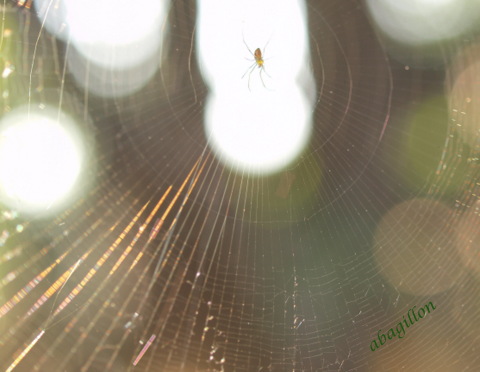
The webs sometimes glitter in the morning specially after the rain.


I see several webs with newly hatched eggs, but this one seems to be the only baby left on its brood.


Close-up of the above spiders


Camera Critters


Saturday, December 4, 2010

Spiders for Intermission

In our property in the province there are many spiders, but i don't really put much attention on them. I know they are part of the biodiversity and ecosystem and they have roles in the food chain and the environment. However, i don't come near the big ones as they really look scary. Besides, the web are so sticky that it is difficult to extricate at times you are not aware it stuck on you.

When my nephew was in grade school he went out with other kids to look for spider species which are used in spider games. They will put 2 opposing spiders on a horizontal stick, spiders will chase and fight until the stronger spider eats the weaker one. Eating involves sucking the prey until all the juices are extracted and the exoskeleton shrunk, until you will not anymore recognize that it was once a spider. The winner who sucked the looser will now bloat to a bigger size. They say it can expand double its size depending on the size of the prey. References say spiders can sometimes stay without food for a long time, but maybe that depends on the species. They are carnivorous and eat insects caught in their webs and also other spiders smaller than themselves.

The yellow ones are the most common and biggest spider i see around
 (Giant wood spider belonging to Nephila species). Look at the web, there are small
red spiders caught there, maybe they will be eaten later or maybe too small for the owner.

they normally build their webs high up on shrubs and trees, and the web
 is made of very sticky golden threads coming out of their bodies

 last summer we saw two colors, yellow and red, but they seem to have the same morphology. We put them on a horizontal stick and observed their actions, but nothing. They don't fight just dislike each other.

We brought them down to see if they will fight but constant prodding did not provoke them. At least one of them will always run away without fighting.

This is another spider which i saw on my Duranta erecta bush.
It is so small but on close -up is very beautiful (close-up below)


This one is a greenish spider which doesn't look as scary as the Giant wood spider. Its web
thread is also fine and not very sticky. The web is also very meticulously done, unlike
the previous spiders above.


Related Posts with Thumbnails