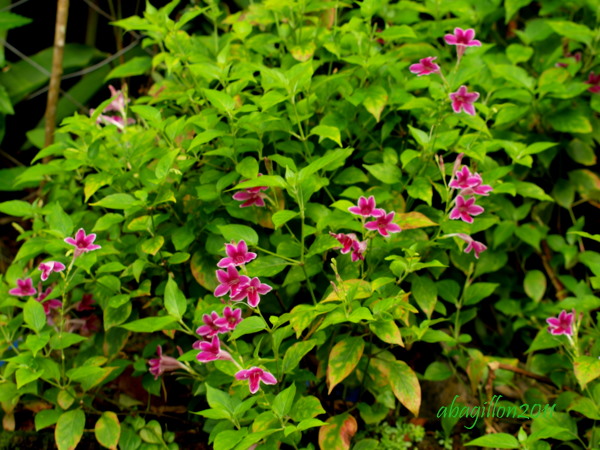
I took these photos in front of a Buddhist shrine in Bangkok, Thailand. The bees are obviously having a feast on them.
Showing posts with label Today's Flowers. Show all posts
Thursday, August 21, 2014
Thursday, May 29, 2014
Orange for May
I am smiling as my title definitely will mislead you! That is the nuisance or maybe beauty of the English language. Being non-English speakers we also have running jokes about English words with the same spelling, but have very different meanings and pronunciation. I guess i am trying to explain my title, and how i was able to misled you. Orange is not just a fruit but also a color. And I have time and again been telling you that we have a lot of orange colors, it is the most predominant color in our climate, of course aside from green. You will not blame me for saying that it bores me sometimes.
My Hippeastrum puniceum that flowered slightly even prior to the heavy rains.
Caesalpinia pulcherrima has 4 colors here in our climate, the red, the pink, the orange and the yellow! it is so alive against the clear blue sky. Butterflies love them too, and our goat kids love eating their leaves.
Their very long filaments supporting the anthers with pollens are seemingly extravagant. I wonder what they signify for the plant to perpetuate the species. Or they might be a disadvantage as the pollens might not attach to the bees sipping nectar. I just don't know!
My Hippeastrum puniceum that flowered slightly even prior to the heavy rains.
an almost spent hippeastrum bloom
Their very long filaments supporting the anthers with pollens are seemingly extravagant. I wonder what they signify for the plant to perpetuate the species. Or they might be a disadvantage as the pollens might not attach to the bees sipping nectar. I just don't know!
Thursday, December 12, 2013
Orange Invaders
Ixora originated from India and Sri Lanka, now popular in tropical America like Florida and Texas and other tropical countries of the world. My orange Ixora is gathered by my mother from relatives and neighbors, now already a permanent resident in our garden, as it is planted on the ground as hedges.
Lantana came from the tropical regions of America and Africa, later introduced to almost all places in the world. My orange lantana above is from a far province in the Visayas, which is Bohol, an island just recently hit by 7.2 magnitude earthquake. This is loved by our butterflies.
Four o'clock, Mirabilis jalapa is also called Marvel of Peru because it came from South America, maybe one of which is Peru. It got the name because if opens in the afternoon and remains open till early morning the next day. It produces lots of seeds and also a root that also remains alive even during droughts. These characteristics make it an invasive species.
My niece and the daughter of my cousin, when they met after several years. My cousin's daughter is an OFW and come home only once-in-a while. They explore places, so i consider them invasives...hahaha!
Monday, April 29, 2013
Orange Enough?
This are not edited in whatever way, except for some cropping. They are mostly introduced species to the Philippines, but gaillardia is the newest addition to my garden sent by my blogger friend from the USA. Hippeastrum puniceum is introduced centuries ago when the Spaniards are still here in the country.
Do you think they are orange enough to merit the Mandarin Orange theme?
Sanchezia speciosa
gaillardia
Friday, October 19, 2012
Thursday, October 27, 2011
Autumn at the World's Other Side
I noticed that most of the garden bloggers are from the temperate climates. Did you observe that? That is advantageous for me, as I see the plants, flowers and gardens uncommon in our tropical conditions. I have always been telling everyone that in Southeast Asia and maybe the Caribbean and those around the equator, we only have two seasons, the dry and the wet. I wonder how most of you from the temperate and sub-temperate regions would feel if you have our conditions. Will you be glad that your garden will not experience winter? Will you be glad you will not be making lots of mitigation such as shade houses or putting your plants inside when the cold strikes? And most of all, the plants are mostly green and continuously flowering throughout the year. Colors are everywhere! And you can leave your garden just by themselves and go to the beach, enjoy the sun and the open skies.
The disadvantage is the deprivation of autumn colors, can you live with that? And of course you will not be able to shovel the snow, and there will be no snowman.
I showed this 2 ft long leaf (Artocarpus spp) as a representation of autumn color. It is the extent of its color before turning brown and totally dry. However, only few leaves exhibit this transformation, most just become brown, fall and decay. It is a continuous process as a result of their age throughout growth and development. And this drying and fall does not happen en masse just like in your Fall/Autumn.
This periwinkle, Catharanthus roseus, flowers all year and is one of the most tolerant of our long dry season. Ours just died because the leaves were all eaten by the sphinx moth larvae. Somehow, it doesn't produce shoots again if all leaves are devoured by larvae. It is cross pollinated so we get other hybrid colors in the next generation.
Lantana camara, also a perennial plant, rain or shine it will not leave you.
This one, Asystasia gangetica, is prolific during the wet season but difficult to withstand the dry if not watered properly.
Turnera subulata, is also prolific because it produces lots of small seed pods which just germinate anywhere. It can also withstand dry season well. But look what happened when there is continuous rain.
These flowers are the result of just a half day continuous rain. The other species which is more yellow and thicker petals, Turnera ulmiflora, is more tolerant of continuous rain. However, because it continuously produce flower buds, the next batch of flowers are ready again the next day.
Celosia argentea or cockscomb
Above and below: Celosia argentea 'plumosa' species
Alternanthera ficoidea
an orchid which flowers the whole year, Epidendrum radicans, but i know it, LOL
The thornless-scentless rose. It just tell us that if we want to smell the roses, we must endure its thorns. This reminds me of Antoine de Saint Exupere "we must be patient with the caterpillars, if we want to be acquainted with the butterflies".
This one looks like a weed, but its color is lovely. I also don't know its name. Thanks for Sunita in supplying its identity as Brazilian button flower or Centratherum intermedium.
Note: We still have a lot of colors now, but the photos might be too heavy in one post!
Tuesday, August 16, 2011
Foreign Plants in my Files
You from the temperate climates have been posting these flowers a few months back in time for your spring. Many blogs I follow take turns posting these flowers, and I've always been elated at them, even if they seem to be the same. That goes true for the crocus and the gallanthus. Crocus differs in colors and forms, but gallanthus is different, except for some patterns and multipetals. Despite its always drooping habit, it is always beautiful and admired.
Now that you are past posting them, it is my time to post mine. They had long been in my files, but I always think of them even if they are alien to our climate. The story and the habitat behind these photos are so special. They are found growing naturally at the top slopes of the rocky mountains of Antalya, Turkey, almost near the snow caps. When the ice melts these flowers start to bloom and the people in the area hold "The Snowdrop Festival" with festivities, dances, and food. Lots of tourists also come. Being in that city that time, we were lucky to be invited to join a group attending the festival. And i didn't think twice in joining. A three-hour trip to the top is an experience of a lifetime.
That was my first time to see crocus, gallanthus, grape hyacinth, and a lot more flowers i still don't know until now. They just look like weeds in their natural habitat, but very fascinating. I was also smitten with the white flowers of the wild plums (below). They grow just near the roadsides at random.
Now that you are past posting them, it is my time to post mine. They had long been in my files, but I always think of them even if they are alien to our climate. The story and the habitat behind these photos are so special. They are found growing naturally at the top slopes of the rocky mountains of Antalya, Turkey, almost near the snow caps. When the ice melts these flowers start to bloom and the people in the area hold "The Snowdrop Festival" with festivities, dances, and food. Lots of tourists also come. Being in that city that time, we were lucky to be invited to join a group attending the festival. And i didn't think twice in joining. A three-hour trip to the top is an experience of a lifetime.
Rocky mountains of Ibradi, Antalya,Turkey
That was my first time to see crocus, gallanthus, grape hyacinth, and a lot more flowers i still don't know until now. They just look like weeds in their natural habitat, but very fascinating. I was also smitten with the white flowers of the wild plums (below). They grow just near the roadsides at random.
I found the above flower in a container in front of a hotel, which magnify its importance. But i haven't been able to know its name. A later comment supplied its name as Lotus bertolii, thank you very much to Veronica of Tassels and Twigs
Lastly, this is my favorite flower, Wisteria sp. I found it for the first time in Sweden trained in a habit much different than this one! I was told that we already have this in our country, but was observed to be invasive, which stopped me from planting it.
Labels:
Outdoor Wednesday,
Today's Flowers,
Turkey,
Wisteria
Subscribe to:
Posts (Atom)