Showing posts with label Blooming Friday. Show all posts

Thursday, December 15, 2011

Garden in December

The more frequent visitors here, most especially my blogger friends, might say that they have already seen my flowers here in the past posts. That is really true! But what can I do when most of these flowers are perennially present in our landscape! Our tropical weather permits them to be alive throughout the year. But of course, some of them also rest for a while during our dry season. They are also afraid to come out for fear of scalding or even burn-out (literally)! But this is still a part of the rainy season, so they are happier these months. By February, they will start to rest a bit and consolidate its energies to bloom profusely again like now.

But even if i have the same kind of flowers here, i don't post the same photos, no worries! When i repost the photo, i will tell you that, or i will include a previous link. So....for my friends at the onset or already in deep winter, I am showing you a panacea for the grey or white environment. Sit and relax, and watch our perennial tropical vegetation.

 Mussaenda philippica 'Doña Luz'

please help me identify this plant

 Turnera subulata

Turnera ulmifolia with a yellow sulfur butterfly

variegated amaranthus

 marigold, Tagetes erecta (2nd generation from seeds courtesy of Skeeter-In the Garden)

 periwinkle, Vinca rosea syn. Catharanthus roseus

candle flower, Pachystachys lutea


 Cat's whiskers, Orthosiphon aristatus


Pentas lanceolata

 thornless red rose

 Asystasia intrusa

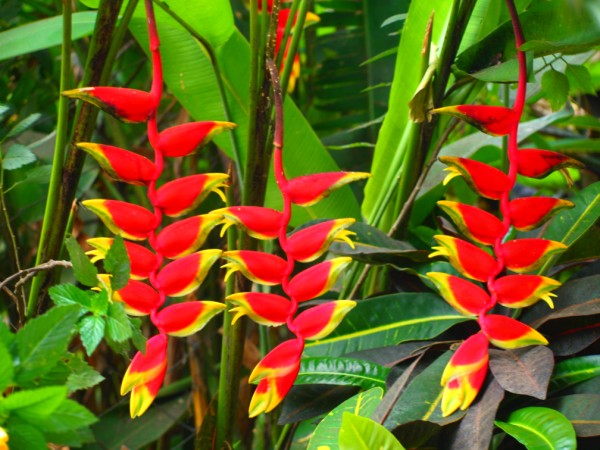
Heliconia

Euphorbia millii


Impatiens balsamina

Sanchezia speciosa 

crotons, Codiaeum variegatum

My Photo  Monatlich  ff 

GBBD         Bloggers Bloom Day         Fertilizer Friday     Blooming Friday


Thursday, April 7, 2011

Eye Candies for Friday

We can find eye candies everywhere! However, choosing 'eye candies' from flowers and plant files seem to be difficult for me. Maybe I am not inspired enough. I somehow want to post a theme with a little deviation from the 'normal theme', which might elicit some fun as One usually does! I wonder what she is up to this time, i know she is contemplating on something. Actually, i am excited, not on mine but on what she might come up with! One day i will also post something hilarious, as in "hilarious"... promise!

These are actually the blooms in our garden, in my mother's care,  neglect rather! You are very familiar with these anyway, so i just need your help in identifying the middle photo. Eye candy or not, others might find them beautiful in their being very ordinary. I followed the common names as i realized some forgot how they are called, just like me i now forgot the others.

Above and below: Heliconia rostrata

Seemania sylvatica (Gesneriad)

Ipomoea horsfalliae (thanks to Autumn Belle for ID)

 Above and below: Periwinkle (Vinca rosea or Catharanthus rosea)

Mussaenda species (one of the Philippines' Doña hybrids)

More Eye Candies at Roses and Stuff
This is linked to Tootsie Time


Monday, December 13, 2010

Let's Think of Grass


Someone reminded me the difference between a grass and a broadleaf! I somehow forgot that difference because in my mind i equated grass with weeds. We only have one local term for both grass and weeds "damo". In local term anything not planted or used as food is "damo". However, weeds are a big group, which include both monocots and dicots. But of course grasses are all monocots, and broadleaves are dicots. Monocots are those with parallel venations on the leaves, while dicots have netted venations. So our local term must have dileneated grass from weed.

Now i recall a simple tutorial on plants for our accountant friend, who is now a president of a big company. We have long discussions and examples to differentiate monocots from dicots, which include all the big ones like bamboo versus mango. You don't assume an accountant to remember monocots and dicots from her Biology class in high school, especially when that has been a few decades ago.

Now let's go back to grasses! I have spotted a few grass flowers lately, so thought of putting them together here. These are all grass weeds. Later, i will be putting the broadleaf weeds.


This is a typical grass, a weed growing on vacant lands as colonizers. They grow at least 2 meters high, but with white beautiful flower spikes. In the first photo, it is growing near a cemented roadside.
They are not very palatable as feeds, maybe because of sharp leaf edges.

The four photos above represent one grass. They are at least 2 ft in height. Animals like cattle, horses and goats also feed on them.

The 2 photos above are the same grass, the 2nd just a close-up of the flowers. They also grow tall like the 1st grass, but this one is shorter and have more colorful flowers. However, they have easily bending stalks. 

 
This is the same flower against the grey cloudy sky.

 The one above have very small flowers that my lens cannot give justice to its details.

This one is maybe the most hated, because they cling to clothes for dispersal. Not only that,
those clinging parts are so sharp and hard that they literally harm and scratch the skin. 

I would like to link this post to  Blooming Friday of Katarina's Roses and Stuff. That is just to provide my temperate country bloggers a BIG Difference, to titillate them that we in this part of the world don't have the Four Seasons. We only have a perennial Summer, with dry and wet months. And our vegetation is also perennially green with lots of loud colors, unless our dry season is so long that kills many plants.

Since these photos are really out in the wilderness and out of the confines of domestic gardens, maybe it is okay to post this in  Outdoor Wednesday courtesy of A Southern Daydreamer.Please visit other participants there.

.

Friday, February 26, 2010

A white Friday: Spider lily

I have long been contemplating on posting white flowers on a Friday. I will shelve the other white flowers this time and contemplate on just one. This is actually ordinary and is also available in temperate climates, the Spider Lily, Hymenocalis spp.  Autumn Belle of My Nice Garden inspired me again with this because of her very beautiful yellow daylily. The white Hymenocallis has many species and varieties.  It is a very versatile plant, for it grows well in shade, semi-shade and in full sun. It is a tropical plant, having it’s origins in South America. This means that in its natural state it grows in soil with a fair degree of moisture most of the time. For a brief description please click  here. For cultural practices please view here, or read here.

Spider plant is a common name which is really very common as many lilies are called spider lilies. There are whites and reds. Spider lilies, when you consult the literatures have many genuses. Some are licorice,  others are hymenocallis, some are crinum. And of course there are more species for each genus. That is the difficulty of using the common name for plants, many sectors or countries have common names which refer to many plants of very different species or genus. This difficulty is erased by using the scientific name, or binomial nomenclature, which refers to the Genus and species of the plant. This is the plant's ID, so wherever they go (from Australia to Zimbabwe) they are known by that name. So the best way is to put the Scientific name enclosed in parenthesis after the common name; e.g. spider lily (Hymenocallis littoralis). Genus starts with capital letter and species starts with small letter. Scientific names are written either in italics or underlined.

Scientific names seem so difficult to pronounce, write or memorize, but plant kingdom will be more chaotic if we are not using this binomial classification. Let us be thankful to Carl Von Linnaeus for starting this orderly classification. He was a Swedish botanist, physician, and zoologist, who laid the foundations for the modern scheme of binomial nomenclature. He is known as the father of modern taxonomy, and is also considered one of the fathers of modern ecology. For more about Linnaeus please read here

Look at those beautifully swaying delicate petals and the upright proud stamens.


The center looks so inviting even for a fly to leave its eggs maybe.
The visitor above is different from the previous one. They really seem to like this spider lily.

I would love to post this to the Blooming Friday hosted by Katarina of Roses and Stuff. The theme is something old and something new, so i discussed something about Carl Von Linnaeus and his binomial nomenclature, which is really very old. My flowers are new! What about that. (hahahaha)
Related Posts with Thumbnails